
Climate change could “push” lamprey, shad and eel northwards, according to the DiadSea project

The sea lamprey, allis shad, European eel and salmon spend part of their lives in rivers and part at sea. The marine phase of their life cycle remains the least understood, and conservation measures in marine environments continue to be insufficient. To address this knowledge gap, the European project DiadSea brought together researchers and organisations from Portugal, Spain, France and Ireland over a three-year period under the coordination of the University of Évora/MARE. The project’s final results were presented on 15 October, during a public session at the University of Évora (SEE HERE).
First comprehensive Atlantic-wide overview
The project compiled and harmonised 42 datasets, covering more than 468,000 sampling operations across 10 species. This work made it possible, for the first time, to develop a comprehensive spatial overview of the presence of these fish species across the Atlantic.
Based on these data, models were developed for all 10 species through to the end of the century. The models predict that species will expand northwards while losing ground in more southerly areas. Community reorganisation is most pronounced under the most severe climate scenario, with losses in the south and gains and species replacement in northern and offshore areas. These findings help identify which regions may become more vulnerable or gain greater importance for conservation, supporting a more preventive and adaptive management approach.
The models also show that the most suitable marine habitats for these species depend on their proximity to the rivers that sustain their populations. This reinforces the need to manage marine and freshwater environments together rather than treating them separately.
“These species do not recognise borders, either between countries or between rivers and the sea. To protect them, it is not enough to know more about their life at sea; countries, institutions, managers, researchers and fishers must work together,” says Catarina Mateus, researcher at MARE–University of Évora and coordinator of DiadSea.
“Mondego Fish”: traceability at the Figueira da Foz fish market
At the Figueira da Foz fish market, the project tested the “Mondego Fish” origin label. The label distinguishes allis shad and twaite shad caught in the River Mondego inland fishery from fish caught at sea or in other areas. By making the origin traceable throughout the supply chain, the initiative adds value to a local product and promotes more sustainable fishing practices. Fish market operators continued applying the labels even without the project team being present, demonstrating that the system has the potential to become part of routine sales practices (SEE HERE).
New techniques and cooperation across four countries
To study the marine phase of species such as sea lamprey, allis shad, European eel, salmon and sea trout, the DiadSea project employed a diverse range of advanced techniques. These included environmental DNA (eDNA), which enables species detection from genetic traces present in water without the need to capture individuals, alongside genetic analysis, otolith microchemistry and electronic tagging.
Diadromous fish and the pressures they face do not respect national borders. For this reason, the project established the Transnational Observatory for the Conservation of Diadromous Fish in June 2025, bringing together representatives from the four participating countries (SEE HERE). In September 2025, DiadSea was recognised as a United Nations Ocean Decade Action (SEE HERE).
To bring science closer to the public and raise awareness of the conservation of these species, the project developed a range of educational resources and outreach materials. These include the card game Migro’Ocean, the floor game The Journey of Migratory Fish, a comic book, explanatory videos and an identification guide available in four languages. All these materials can be accessed AT THIS LINK.
Examples of press coverage
- Alterações climáticas podem deslocar lampreias e sáveis para norte (Mais Ribatejo)
- Alterações climáticas podem empurrar lampreias, sáveis e enguias para norte até ao final do século (Ambiente Magazine)
- Alterações climáticas podem empurrar lampreia, sável e enguia para norte (Tinta Fresca)
- Alterações climáticas podem empurrar lampreia, sável e enguia para norte (SAPO)
Related articles & News
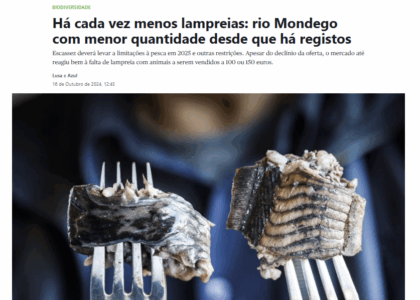
Article in national (PT) news (10/2025)
Available here: https://www.publico.pt/2024/10/16/azul/noticia/ha-menos-lampreias-rio-mondego-menor-efectivo-desde-ha-registos-2108102